U.S. Steel Market Research Report – Segmented By Product (Flat Steel, Long Steel), Application and Country – Industry Analysis From 2025 to 2033
U.S. Steel Market Size
The U.S. steel market was valued at USD 1.33 billion in 2024, is estimated to reach USD 1.37 billion in 2025, and is projected to reach USD 1.94 billion by 2033, growing at a CAGR of 4.86% from 2025 to 2033.
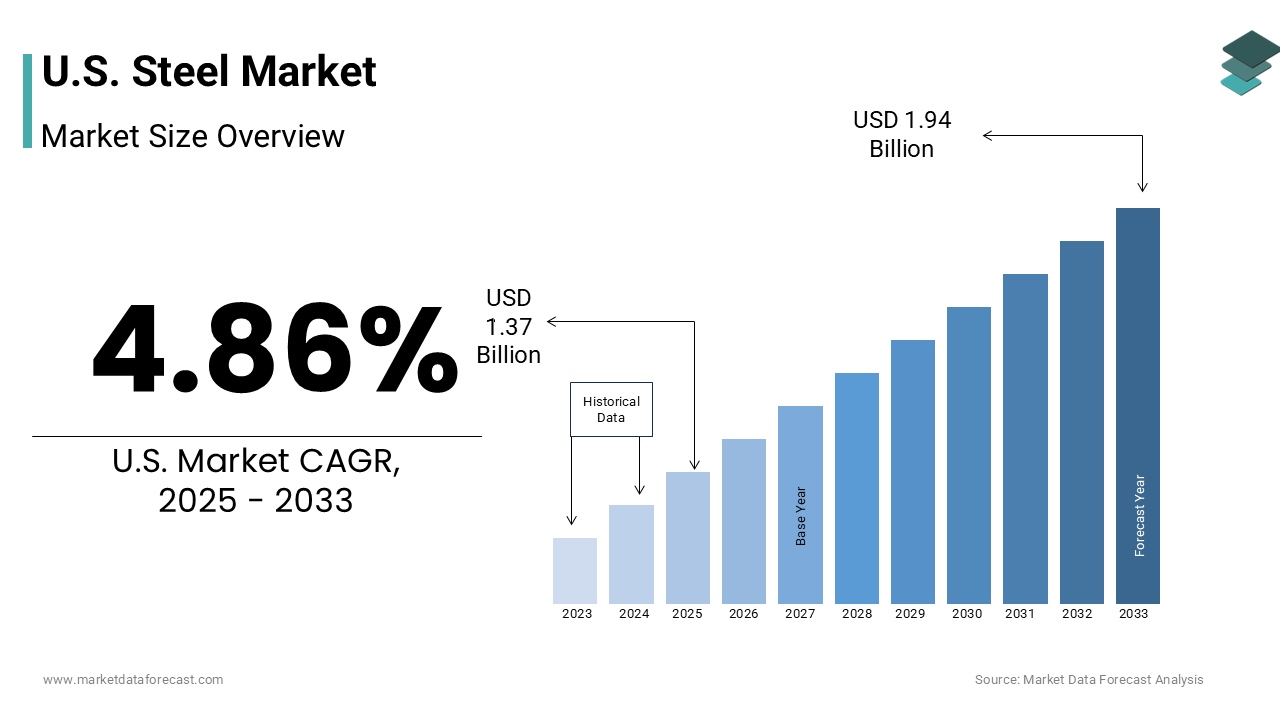
The steel constitutes the engineered core of American industrial capacity, which is supplying the essential material substrate for infrastructure, defense, mobility, and energy systems. Used in countless applications, steel is the backbone of infrastructure, from buildings and bridges to railways and pipelines. It is also essential for manufacturing vehicles, machines, tools, and household appliances. Highly recyclable, steel can be reused endlessly without losing its quality, supporting a sustainable and circular economy. As per the USGS's Mineral Commodity Summaries 2024 reports that U.S. raw steel production in 2023 was an estimated 80.5 million metric tons. According to the USGS data, that in 2023, EAFs accounted for 71% of U.S. raw steel production.
MARKET DRIVERS
Infrastructure Modernization as a Structural Demand Anchor
The escalation in the modernization in the infrastructure is significantly driving the U.S Steel Market. The passage of the Infrastructure Investment and Jobs Act has institutionalized steel demand through $1.2 trillion in federally backed projects targeting roads, bridges, and grid modernization through 2026. As per the Congressional Budget Office, these initiatives will absorb million tons of structural steel annually by 2025. As per the American Road & Transportation Builders Association identifies many structurally deficient bridges requiring steel-intensive rehabilitation, with each major span consuming 5,000 to 15,000 tons. The legislatively secured, multi-decade demand corridor insulated from economic cycles is enhancing the market growth.
Industrial Reshoring and Advanced Manufacturing Expansion
The return of heavy manufacturing particularly in electric vehicles, battery gigafactories, and defense platforms is generating high-value steel demand uncorrelated with traditional construction cycles, which is escalating the U.S. Steel Market growth. According to the Reshoring Initiative’s 2023 report, announced domestic projects will require millions of additional tons of advanced steel by 2027. Ford Motor Company’s BlueOval City complex in Tennessee alone will consume thousands of tons annually of high-strength steel for its F-Series Electric platform. As per the Department of Defense’s Industrial Base Analysis projects an increase in defense-sector steel demand through 2026, which is driven by naval shipbuilding and armored vehicle programs. This reshoring wave elevates not just volume, but product complexity and pricing power for U.S. mills
MARKET RESTRAINTS
Energy Cost and Environmental Compliance Disadvantages
The U.S. integrated steelmakers face persistent cost penalties due to elevated energy pricing and stringent emissions regulation is majorly restraining the U.S Steel Market. As per the Energy Information Administration, natural gas costs for U.S. blast furnaces average $7.80 per million BTU, which is inflating production expenses. As per the Environmental Protection Agency’s 2023 inventory confirms steel contributes to U.S. greenhouse gas emissions, which is triggering mandatory reporting and potential carbon fees. According to the American Council for Capital Formation estimates compliance adds $18–$25 per ton to production costs. These structural burdens erode export competitiveness and invite substitution by lower-cost imports, particularly in non-defense, price-sensitive sectors such as commercial construction.
Skilled Labor Shortages Constraining Operational Throughput
A demographic and vocational deficit in metallurgical and machine operation roles is throttling capacity utilization across the value chain. According to the Bureau of Labor Statistics, staffing for rolling and furnace operations remains below pre-pandemic levels, with average operator age exceeding. For Instance, the Fabricators & Manufacturers Association reports that 68% of service centers experience delays fulfilling precision orders due to welder and CNC technician scarcity. For Instance, the National Center for Construction Education and Research states only 12% of vocational programs offer steel-specific certifications. The result: mills with full order books face throughput ceilings, which is forcing premium pricing and delivery extensions that incentivize offshore substitution
MARKET OPPORTUNITIES
Green Steel Transition via Hydrogen-DRI Pathways
The convergence of federal incentives and corporate procurement is escalating investment in near-zero-emission steelmaking, which is creating significant opportunities in the U.S. Steel Market. As per the U.S. Department of Energy’s Hydrogen Shot initiative, pilot facilities in Indiana and Ohio aim to produce millions of tons annually of hydrogen-reduced steel by 2027. For Instance, the Inflation Reduction Act’s 45V tax credit up to $3/kg for clean hydrogen, which effectively subsidizes $85 per ton of green steel. Major off-takers including General Motors and Ørsted have signed supply MOUs, is creating a premium segment insulated from commodity volatility. This transition transforms environmental compliance from cost center to value driver, which is positioning early adopters as leaders in the low-carbon industrial economy.
Defense-Driven Supply Chain Sovereignty
Steel’s designation as a significant material under the Defense Production Act unlocks institutional demand and capital support is propelling the growth opportunities in the U.S. Steel Market. As per the report, the U.S. targets 100% domestic sourcing of defense-grade steel by 2028, which is backed by $4.3 billion in Title III modernization funding. As per the Defense Logistics Agency awarded millions in 2023 to upgrade armor and naval steel foundries. Section 232 trade mechanisms now prioritize domestic mills for infrastructure and defense contracts, which effectively ring-fencing volume. This creates a price-stable, long-term demand segment is repositioning U.S. mills as national security enablers rather than cyclical commodity suppliers, with guaranteed procurement anchoring investment confidence.
MARKET CHALLENGES
Feedstock Challenges in U.S. Minimills
The feedstock foundation of U.S. minimills which produce 71% of domestic steel is under strain due to inefficient scrap collection and export outflows, which is creating challenges in the growth of U.S. Steel Market. According to the Institute of Scrap Recycling Industries, domestic scrap generation grew in 2023 despite record steel output, which is pushing prices up year-over-year. As per the U.S. International Trade Commission reports ferrous scrap exports surged to 18.4 million tons in 2023, as overseas buyers outbid domestic mills. According to the Environmental Protection Agency estimates 14 million tons of recoverable steel are landfilled annually due to municipal collection gaps. Without federal scrap retention policies or circular economy mandates, EAF mills face chronic feedstock insecurity and margin compression.
Implications for U.S. Steel Market Expansion
Aging rail and port infrastructure is eroding the competitiveness of inland steel producers despite robust manufacturing capacity is posing challenges in the expansion of U.S. Steel Market. As per the Surface Transportation Board’s 2023 analysis, dwell times for coil shipments from Gary, Indiana to Southeastern auto plants increased to 6.8 days, which is longer than 2019, due to track congestion and labor shortages. According to the American Association of Port Authorities states only three of the top ten steel-importing ports have dedicated heavy-lift slab cranes, which is causing demurrage costs to rise since 2021. This logistical friction undermines just-in-time manufacturing models and incentivizes buyers to source from coastal or foreign suppliers with superior throughput a structural vulnerability that, if unaddressed, will cede market share irrespective of production capability.
REPORT COVERAGE
| REPORT METRIC | DETAILS |
| Market Size Available | 2024 to 2033 |
| Base Year | 2024 |
| Forecast Period | 2025 to 2033 |
| Segments Covered | By Product, Application and Region. |
| Various Analyses Covered | Global, Regional, & Country Level Analysis; Segment-Level Analysis, Drivers, Restraints, Opportunities, Challenges, PESTLE Analysis, Porter’s Five Forces Analysis, Competitive Landscape, Analyst Overview of Investment Opportunities |
| Key Market Players | Nucor Corporation, Steel Dynamics, Inc., Reliance Steel & Aluminum Co., United States Steel Corporation, Commercial Metals Company, and Cleveland-Cliffs Inc. |
SEGMENTAL ANALYSIS
By Product Insights
Flat steel segment led the U.S. Steel Market with significant share in 2024. The segment is dominating due to its irreplaceable role in automotive panels, appliance shells, and energy infrastructure. According to the Department of Energy’s Wind Energy Technologies Office confirms that each utility-scale turbine requires 220–250 tons of high-strength flat-rolled steel for towers and nacelle housings with thousands of turbines installed in 2023 alone demanding nearly 1 million tons. For Instance, the U.S. International Trade Commission documents that most of the imported automotive body panels retain U.S.-made substrate due to dimensional precision mandates under USMCA rules of origin. This technical indispensability, coupled with reshoring of EV battery enclosures requiring corrosion-resistant coated steels, which entrenches flat products as the non-substitutable core of advanced manufacturing.
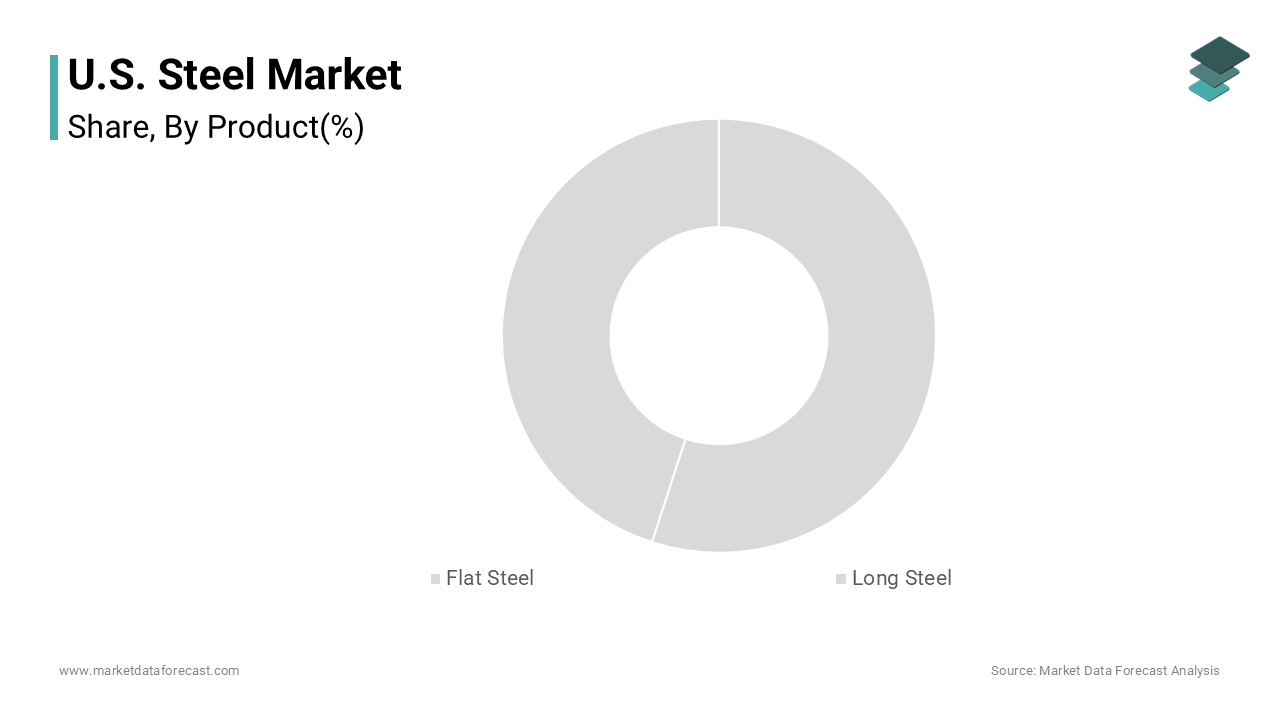
The long steel segment including rebar, beams, and rails is expanding at a 6.8% CAGR from 2025 to 2033. This surge is propelled by federally funded bridge and rail projects. As per the Federal Railroad Administration’s CRISI grant program allocated billions in 2023 for track modernization, by consuming thousands of tons in rail-grade long steel. According to the Build America, Buy America Act mandates 100% domestic content for federally funded infrastructure, which is locking in procurement for U.S. mills. This policy-backed, project-driven demand creates a structural growth corridor insulated from consumer cyclicality.
By Application Insights
Building and construction segment dominated the U.S. Steel Market by capturing 41.7% of share in 2024. The segment growth is driven by non-residential development and public works. As per the reports that billions invested in commercial and institutional projects broke ground in 2023, with steel framing specified in most of the structures exceeding five stories due to seismic and fire code compliance. According to the General Services Administration’s 2023 Federal Buildings Census confirms most of the new government facilities utilize structural steel frames for lifecycle cost efficiency. Simultaneously, the National Association of Home Builders documents an increase in steel-intensive multi-family housing starts in 2023, which is responding to urban density mandates and labor shortages favoring prefabricated systems. This institutional, code-driven demand renders construction the most volume-stable steel-consuming sector.
Heavy industries segment is projected to grow at a CAGR of 8.1% in U.S. Steel Market between 2025 to 2033. The energy, mining, and industrial machinery represent the fastest-growing application. The segment is growth is fueled by capital reinvestment in clean energy and resource extraction. As per the U.S. Energy Information Administration forecasts various new lithium and rare earth processing facilities by 2027, each consuming 15,000–20,000 tons of abrasion-resistant plate. Simultaneously, Caterpillar and Komatsu expanded U.S. production of mining haul trucks in 2023, which is increasing demand for ultra-high-strength wear plate. This segment’s expansion is technologically and policy-anchored by demanding premium alloys and commanding long-term supply contracts.
REGIONAL ANALYSIS
United States Steel Market Analysis
The United States functions not as a price-taker but as a value-definer in global steel market by leveraging policy, technology, and strategic procurement to insulate its industrial base. According to the World Steel Association, the U.S. ranked fourth globally in 2023 with 88.3 million metric tons of crude steel output, which is trailing China, India, and Japan yet commands disproportionate influence through regulatory frameworks and defense-linked demand. As per the U.S. International Trade Commission, that most of steel-consuming sectors under federal jurisdiction, which includes shipbuilding, rail, and energy. For Instance, the Department of Commerce’s Section 232 tariffs, maintained since 2018, continue to shield strategic grades from import surges, by preserving mill viability. Unlike volume-driven exporters, the U.S. competes on specification integrity, supply chain sovereignty, and embedded policy, which is transforming steel from commodity to controlled industrial asset.
COMPETITVE LANDSCAPE
Competition in the U.S. Steel Market is defined by technological sovereignty, policy insulation, and embeddedness in downstream innovation ecosystems rather than commodity pricing. Players compete on carbon transparency, metallurgical customization, and supply chain resilience. Differentiation stems from proprietary alloys, digital traceability, and co-engineering with global OEMs. With Asia Pacific demanding low-emission, high-specification steel for EVs and renewables, U.S. mills leverage regulatory tailwinds like Buy America and Section 232 to shield domestic capacity while exporting value-added solutions. The battlefield has shifted from blast furnace efficiency to lifecycle certification and IP-protected processing, which is making competition a contest of standards, not scale.
KEY MARKET PLAYERS
A few of the major companies in the U.S. Steel Market include
- Nucor Corporation
- Steel Dynamics, Inc.
- Reliance Steel & Aluminum Co.
- United States Steel Corporation
- Commercial Metals Company
- Cleveland-Cliffs Inc.
Top Players in the Market
Nucor Corporation leverages its dominance and scrap-based EAF technology to supply high-strength, low-carbon steel to regional infrastructure and automotive sectors. In 2023, it expanded its Singapore-based distribution hub to serve Southeast Asian rail and EV battery enclosure projects. In early 2024, Nucor launch “GreenCert,” a blockchain-tracked low-emission steel offering for Japanese and Korean automakers. It also partnered with Thailand’s Eastern Seaboard Industrial Zone to pre-position certified coils for regional Tier-1 suppliers. These moves embed Nucor as a sustainability-compliant, logistics-optimized supplier, which is aligning with Asia’s tightening Scope 3 emissions mandates and reshoring trends.
Cleveland-Cliffs Inc., as North America’s largest flat-rolled steel producer, supplies advanced automotive and electrical steels strategic alloy partnerships. In late 2023, it initiated direct shipments of grain-oriented electrical steel to Vietnam’s transformer manufacturers, bypassing traditional Japanese intermediaries. In Q1 2024, it co-developed a 1,500 MPa press-hardened steel grade with Hyundai Motor Group for next-gen EV platforms. Simultaneously, it established a technical center in Taipei to support Taiwanese semiconductor equipment builders requiring ultra-flat, which is thermally stable substrates. These initiatives position Cleveland-Cliffs not as a bulk exporter but as a solutions architect by embedding its metallurgical expertise into Asia’s high-tech and mobility value chains.
Nippon Steel’s ownership functions as a trans-Pacific technology conduit, which is transferring proprietary steelmaking and coating processes to regional market. Post-acquisition integration in early 2024 enabled U.S. Steel to license its Big River Steel thin-slab casting technology to a Malaysian joint venture targeting ASEAN EV battery enclosures. It also launched “SteelSecure,” a digital platform offering real-time chemistry and tensile data to Korean shipbuilders sourcing U.S.-origin plate. In March 2024, it signed a 10-year supply agreement with Japan’s JFE Steel for decarbonized slab exchange by balancing regional carbon costs. These actions reposition U.S. Steel as a global innovation node, which is leveraging ownership structure to deepen technical entrenchment across regional premium steel segments.
Top Strategies Used by Key Market Participants
Key players deploy decarbonization certification, trans-Pacific technology licensing, regional alloy co-development, digital traceability platforms, and policy-aligned export frameworks to fortify market positioning. They embed environmental product declarations verified by third parties to satisfy Asia’s green public procurement rules. Strategic licensing of proprietary processes enables local production without volume dilution. Joint development of advanced high-strength grades with OEMs locks in multi-year contracts. Digital platforms provide real-time mill data, which is reducing rejection rates. Participation in bilateral critical minerals dialogues shapes steel inclusion in regional content mandates, preempting trade barriers and institutionalizing U.S. steel within Asia’s industrial sovereignty frameworks.
RECENT MARKET DEVELOPMENTS
- In March 2024, Nippon Steel publicly committed to continuing its pursuit of acquiring U.S. Steel following a December 2023 agreement. The merger was completed in June 2025.
- In March 2025, Cleveland-Cliffs announced plans to idle its Dearborn Works plant, which uses traditional coal-based steel production.
MARKET SEGMENTATION
This research report on the U.S. Steel market has been segmented & sub-segmented into the following categories.
By Product
- Flat Steel
- Long Steel
By Application
- Building & Construction
- Automotive & Transportation
- Heavy Industry
- Consumer Goods
- Others
By Country
- The United States
Frequently Asked Questions
What feedstock challenges are U.S. minimills facing in the steel market?
In the U.S. Steel Market, minimills producing 71% of domestic steel are facing feedstock strain due to inefficient scrap collection, high scrap export outflows, and landfilling of recoverable steel.
How are scrap exports affecting the U.S. Steel Market?
According to U.S. International Trade Commission reports, ferrous scrap exports surged to 18.4 million tons in 2023, which outbid domestic mills and created supply challenges in the U.S. Steel Market.
What challenges do EAF mills face in the U.S. Steel Market?
Without federal scrap retention policies or circular economy mandates, EAF mills in the U.S. Steel Market face chronic feedstock insecurity and margin compression.
How do logistical issues impact just-in-time manufacturing in the U.S. Steel Market?
Logistical inefficiencies, such as port and rail delays, undermine just-in-time manufacturing models and incentivize buyers to source from coastal or foreign suppliers.
Are there policies supporting scrap retention in the U.S. Steel Market?
Currently, the U.S. Steel Market lacks federal scrap retention policies or circular economy mandates, exacerbating feedstock insecurity for steel producers.
What is the future outlook for the U.S. Steel Market?
The future outlook of the U.S. Steel Market indicates moderate growth, driven by domestic demand from automotive, construction, and infrastructure sectors. However, the market faces challenges from feedstock shortages, aging rail and port infrastructure, rising scrap prices, and international competition. Investments in green steel technologies, modernization of EAF mills, and potential federal policies on scrap retention could improve competitiveness and sustainability in the coming years.
Access the study in MULTIPLE FORMATS
Purchase options starting from
$ 1200
Didn’t find what you’re looking for?
TALK TO OUR ANALYST TEAM
Need something within your budget?
NO WORRIES! WE GOT YOU COVERED!
Call us on: +1 888 702 9696 (U.S Toll Free)
Write to us: sales@marketdataforecast.com